SeeForMe
AI-powered visual assistance platform that provides real-time environmental navigation, image description, and color blindness tools for visually impaired users using YOLO v11 and LLM integration.
Team Members:
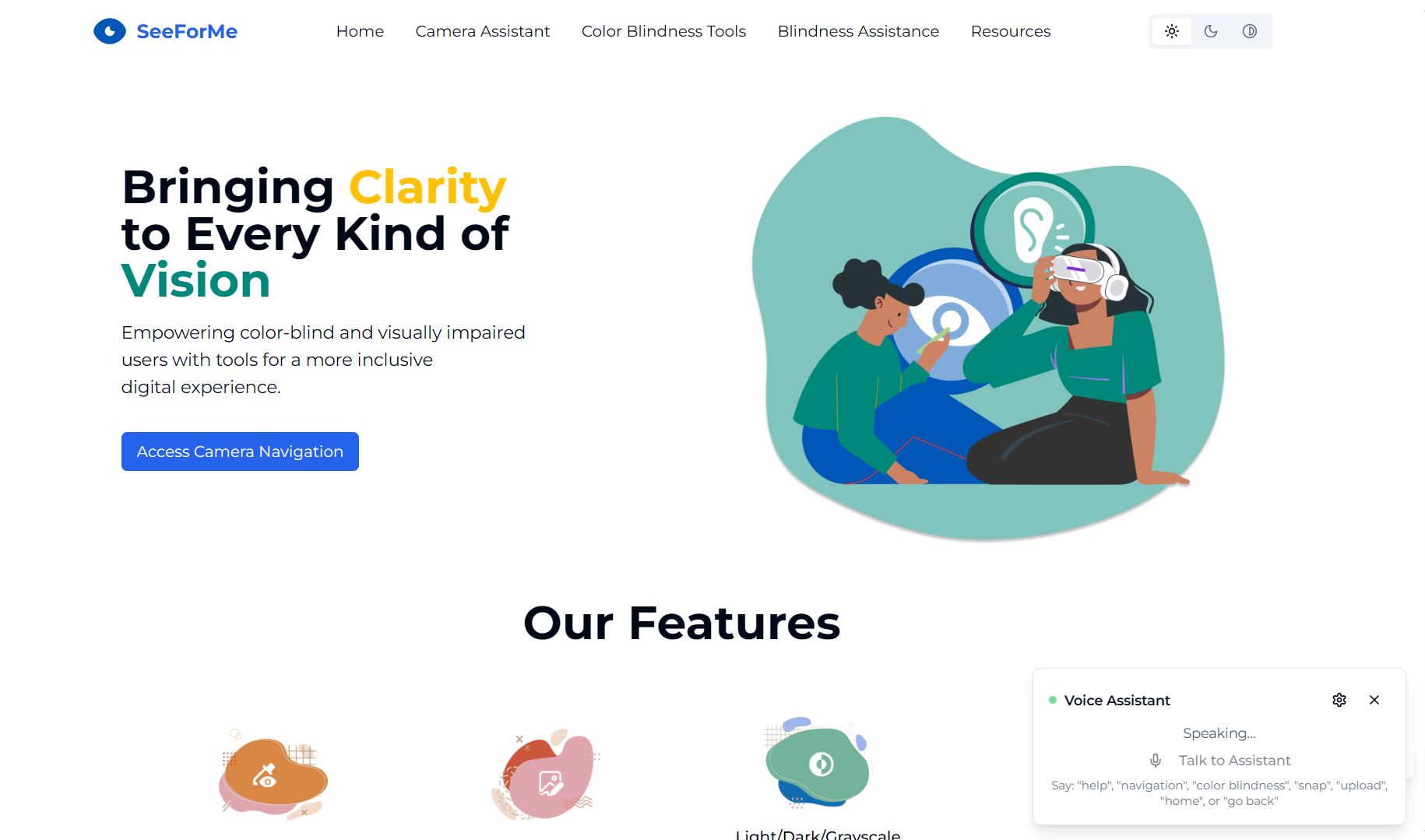
Project Overview
An AI-powered visual assistance platform that provides real-time environmental navigation, image description, and color blindness tools for visually impaired users using YOLO v11 and LLM integration.
Key Features
- Real-time environmental navigation with custom-trained YOLO v11 object detection
- Instant image description using Gemini API with voice output
- Color blindness simulation tools for multiple vision deficiencies (Protanopia, Deuteranopia, Tritanopia, Achromatopsia)
- Voice-controlled navigation and commands via Web Speech API
- Hands-free keyboard navigation shortcuts for accessibility
- Live camera streaming with Socket.IO for real-time guidance
- Context-aware navigation instructions powered by GROQ LLM
- Cross-platform compatibility (web/mobile) with responsive design
- Open-source codebase focused on accessibility and inclusivity
Challenges & Solutions
- AI Model Integration: Successfully combined YOLO v11 object detection with LLM reasoning to provide contextual, actionable navigation instructions rather than simple object identification
- Real-time Performance: Implemented efficient Socket.IO streaming to handle live camera feeds while maintaining low latency for critical navigation guidance
- Cross-platform Accessibility: Addressed platform-specific limitations (iOS voice restrictions) while ensuring consistent user experience across devices
- Custom YOLO Training: Developed specialized object detection model trained on environmental obstacles and navigation-relevant objects for improved accuracy
- Voice Interface Design: Created intuitive voice command system with clear audio feedback, essential for users who cannot see visual confirmations
- Accessibility-First UI: Designed interface following WCAG guidelines with high contrast, screen reader compatibility, and keyboard-only navigation support
System Architecture
Architecture Overview
SeeForMe employs a sophisticated multi-tier architecture that seamlessly integrates computer vision, natural language processing, and real-time communication to deliver comprehensive visual assistance.
Frontend Architecture (React + Vite)
The frontend is built using React with Vite for optimal performance and development experience, featuring:
-
Component Structure:
- Main Dashboard with feature selection
- Camera Interface for real-time navigation
- Image Upload/Capture components
- Color Blindness Simulation tools
- Voice Command Interface
- Accessibility Navigation components
-
Key Technologies:
- TailwindCSS: Utility-first styling with accessibility-focused design
- Socket.IO Client: Real-time bidirectional communication
- Web Speech API: Voice recognition and text-to-speech functionality
- Gemini API Integration: Direct frontend image description processing
- Responsive Design: Mobile-first approach with cross-device compatibility
-
Accessibility Features:
- ARIA labels and semantic HTML structure
- High contrast color schemes
- Keyboard navigation support
- Screen reader compatibility
- Voice command integration
Backend Architecture (Python + Flask)
The backend serves as the AI processing engine, handling complex computer vision and natural language tasks:
-
Core Framework:
- Flask: Lightweight web framework for API endpoints
- Flask-SocketIO: Real-time WebSocket communication
- OpenCV: Computer vision and image processing
- Ultralytics YOLO v11: Custom-trained object detection model
-
AI Pipeline:
- YOLO v11 Object Detection: Custom-trained model for environmental object recognition
- GROQ LLM Integration: Context-aware instruction generation
- Real-time Processing: Efficient frame processing for live camera feeds
- Multi-threaded Processing: Concurrent handling of multiple user sessions
Real-Time Communication Flow
Frontend Camera → Socket.IO → Backend Processing → YOLO Detection → LLM Context → Voice Instruction → Frontend Audio Output
AI Model Integration
YOLO v11 Custom Training:
- Trained on environmental obstacles and navigation-relevant objects
- Optimized for real-time inference on mobile devices
- Custom classes for accessibility-specific scenarios
LLM Context Processing:
- GROQ API integration for natural language instruction generation
- Context-aware responses based on detected objects and user location
- Concise, actionable guidance optimized for audio delivery
Gemini API Integration:
- Frontend-direct image description processing
- Multi-modal understanding for complex scene analysis
- Real-time image-to-text conversion with accessibility focus
Data Flow Architecture
-
Real-time Navigation:
- Camera stream → Frontend capture → Socket.IO transmission
- Backend YOLO processing → Object detection → LLM context generation
- Instruction delivery → Text-to-speech → User audio feedback
-
Image Description:
- Image capture/upload → Gemini API processing
- Description generation → Voice output → User feedback
-
Color Blindness Simulation:
- Image processing → Frontend color transformation
- Multiple deficiency type simulation → Visual comparison display
Security & Performance
- Secure Communication: HTTPS/WSS protocols for all data transmission
- Efficient Processing: Optimized YOLO inference for mobile devices
- Error Handling: Comprehensive fallback mechanisms for AI service failures
- Privacy-First: No permanent storage of user images or personal data
Deployment Architecture
- Frontend: Static deployment optimized for CDN delivery
- Backend: Containerized Flask application with auto-scaling capabilities
- AI Models: Optimized model serving with GPU acceleration support
- Real-time Infrastructure: WebSocket connection management with session handling